Showing posts with label gold lace. Show all posts

Wednesday, 7 October 2015

Lyon - Musée des Marionettes du Monde

Lillian: The Musées Gadagne are in 2 parts - the History of Lyon museum we saw in the last post - in this post we will see something of the Musée des Marionettes du Monde ... the Museum of the Puppets of the World.

Audrey:  Well, not wanting to disappoint people who really like puppets but the camera clicker found most of the puppets rather creepy so ...

Lillian:  Of course, creepy is in the eye of the beholder - you know, some people find Blythe dolls a bit creepy ...

Audrey: Well!  huff  there is no accounting for taste!


Lillian:  These Ballerina marionettes are quite lovely


as is this Lady from Venice and dating from the 1700s.


Lillian:  Our photographer is somewhat obsessed about historical costume and textiles - especially lace. 
The lace over-skirt on that marionette is very lovely - possibly hand embroidered on muslin.  Of course, puppets' clothes are like dolls' - often made from left-over scraps or cut-down from human sized garments.  So they can be a source for fabulous textiles.

Audrey:  Although the camera clicker didn't take many photos of the puppets - she did take some close-up pictures of the lace on their clothes.


Lillian:  This Don Quixote gent had a wonderful outfit - including this lace.  Had it been a human's cravat end or a cuff frill?   Definitely hand made but we're unsure what type of lace it is.
More research needed.

An expensively attired lady puppet


bobbin lace - would we call this Cluny style?


Lillian: This gent is wearing a lot of lace - a simple bobbin lace for his cravat and on his coat is some gold lace.

Audrey:  What - real gold?!!

Lillian:  Yes, thread with thin strips of real gold wrapped around it.  It must've been stiff & difficult to work with but they made bobbin lace from it - and it was sold by weight.
Now no museum of Puppets of the World would be complete without some Indonesian shadow puppets, Wayang Kulit ...
from Java, 1850

 
 Lillian:  And this chap is a Kasparek, from Prague, 1928.  Kasparek or Kasperle / Kasper is a German / Austrian tradition - he is rather like the English Punch (and Judy).  The French have their own version and he originated in Lyon and his name is Guignol. 

Guignol was created around 1808 by Laurent Mourguet -  like the English Punch he is rather violent and uses a split stick as a weapon (the split stick makes a loud noise - which is why it is called a slap-stick ... ) 

This Guignol puppet was made by Mourguet
All these puppets, Punch, Kasperle & Guignol have their origins in the Italian Pulcinella in the Italian Commedia dell'arte.  

In the stories Guignol is often a silkweaver (like much of his original audience) and he is always very poor.  He is cheeky, clever & courageous - has a strong sense of justice and inevitably the story is of triumph of good over evil. 

Audrey:  Guignol is a glove puppet - whereas the Kasperle is a marionette, on strings. 

Lillian:  Yes, the English Punch is traditionally a glove puppet too.  We should say that the French use the word marionette for all puppets and those with strings are called marionettes à tringle et fils or marionettes à fils.

Audrey: I found a statue of Laurent Mourguet near the museum - the top part  is quite charming with Mourguet interacting with the puppet he created ...

but on the side - some of that slap-stick violence you were talking about


just above that unpleasantness, there is a reference to silk weaving with a bobbin of thread, clippers ... a shuttle ...


Lillian:  But back to the museum for a bit - because the buildings are quite lovely examples of Renaissance architecture.
Audrey: With a tower and courtyards ... 


A nice doorway

Audrey:  But best of all was the very thoughtfully provided Blythe swimming pool ...


And when we got back to our hotel - the mural at the entrance made far more sense  ...

Hello Guignol!

Sunday, 29 July 2012

Nancy - le Musée Lorrain in the Ducal Palace

Angel of the Annunciation - 16th C.
Lillian :  We have a touristy tip - when you are in a new place make sure to visit the regional museum - the Museum that focuses on the culture of that particular place.  It helps to get a real feel of the history of an area and the culture - what makes that area special.

Audrey :  Good tip Lillian,  the Musée Lorrain is in the splendid Ducal Palace & the ex-Franciscan monastery next door.  

In this post we'll show you photos of some of the things in the Ducal Palace.


Lillian :  Most museums & art galleries in Europe allow photography - just don't use the flash. 

Audrey :  Our stylist thought this was a marvelous opportunity to gather research on historical fashions and on lace - so we have lots of photos of clothes ... and the details of garments ...


Lillian :  We've started with some splendid stained glass and the last 2 photos are parts of an Adoration of the 3 Kings (in French - l'adoration des Rois mages) from the l’église Sainte-Ségolène in Metz  dated approx. 1390 and attributed to Hermann von Münster ...
Audrey :  Wasn't Herman Munster on the TV??
Lillian :  I think that was a different Monster umm I mean Munster.  Did you notice the fantastic detail of the shoes and scalloped edges?


Audrey :  More lovely detail in the cap and garments in this bas-relief altarpiece of the Lamentation of Christ from the early 1600s.  It is of "polychromed alabaster" - we think that means that it was painted.  

Lillian :  Apparently Lorraine produced a lot of alabaster statuary but few examples remain.


Lillian :  The Ducal Palace was built in the 15th C for René II and I think that this is a statue of him - he is often pictured on a horse and waving a sword about ... notice the thistle on the pedestal (it's a symbol of Lorraine).
Audrey :  You are looking rather swashbucklish yourself with your velvet pants and froggy boots! 
Lillian :  Urr thanks.  While we are thinking about weaponry - what about the cabinet with the wax-work diorama in it.
Audrey :  A beautiful cabinet but ... the subject of the wax-work diorama was quite horrible. 

Lillian :  The Martyrs de Trèves (Trier) - this cabinet was made in Germany in 1759.  The subject is horrid but you have to admire the work that went into making it - the wax figures are amazingly detailed - here is some detail - with the reflections off the glass this is the best photo our people could get...
Audrey :  All those little wax figures - and he isn't wearing very much.  Is that his underwear showing over his tights?  
Lillian :  Looks like it - perhaps braies (medieval underwear for men) were worn with hose ... 
Audrey :  And I thought that showing the top of your undies above your trousers was a recent male fashion.
Lillian :  Well, fashion has a habit or repeating itself.  Let us look at more historical fashions in some portraits.

Audrey :  That is sweet - 2 paintings of the same person.  Nicole de Lorraine at 13months old in 1607 and then all grown up.
 Lillian :  Nicole, Duchess of Lorraine was the only surviving child of Henri II Duke of Lorraine, but she couldn't inherit the Duchy because she was a woman.  She married the eldest son of the Count of Vaudémont and he became Charles IV, Duke of Lorraine.  The marriage was not a happy one and they had no children.
Audrey :  Oh that's sad - she looks like a dolly in all that dress & lace as a baby - and the collar in the other portrait looks so very Art Deco!
 Lillian :  I guess the collar was very fine and very starched linen.  Here are more important people wearing uncomfortable clothes.
Audrey :  Click on the details to see the wonderful lace.  His frills are all gold lace - it was bobbin / pillow lace made from gold thread, actual gold - it was sold by the weight.  Who was this gent with the 'five o'clock shadow'?

Lillian :  He was François III, Duke of Lorraine, & François I, Marie-
Thérèse of Austria who is in the other portrait of this pair - attributed to Martin van Meytens.


Audrey :  Oh - they are Marie Antoinette's mum & dad.
Lillian :  Yes, Marie Antoinette was the 2nd youngest of their 16 children.
Audrey :  A typical over-achieving couple of the 18th Century!
Lillian :  François III was the last Duke of Lorraine.  Under the Treaty of Vienna in 1738, Louis XV gave Lorraine to his father-in-law and ex-King of Poland - Stanisław Leszczyński.

Audrey :   This portrait (C.1740) is of Stan's wife Catherine Opalinska. 


and, wearing a very similar frock is her daughter Marie.  


This portrait (C.1726 by Francois Stiemart) shows Marie shortly after her marriage to Louis XV, she is holding a branch of orange blossom.


Audrey :  While we are with Stan's family, remember the well-dressed ... well we thought this was a puppet.
Lillian :  It is actually a life-sized mannequin of Nicolas Ferry, known as Bébé (1741–1764).   A Little Person (he grew to only 34" / 86cm) he was quite a favourite in Stanislaw's court;  Bébé was famous for his pranks and jokes.  Recent researchers think Nicolas had a very rare form of dwarfism. 
Audrey :  Those clothes were actually his.  
Lillian :   Stanislaw had his court in Lunéville, an area still famous for its ceramics & pottery.  There are some nice examples in the Musée Lorrain ...
The Gardener
after Paul-Louis Cyfflé (1724-1806)
Biscuit de terre de Lorraine


Epergne - Leda & the Swan - C.1770
after Paul-Louis Cyfflé Biscuit de terre de Lorraine


Audrey :  You liked that gazebo - I rather liked this chap - General Maximilien-Sébastien Foy.
General Foy (1775-1825)
Manufacture de Niderviller C.1820


Notice the M cuts in his collar.

Jeune femme et l'enfant
Pierre Jospeh Michel 1781

I found this terracotta figurine quite charming


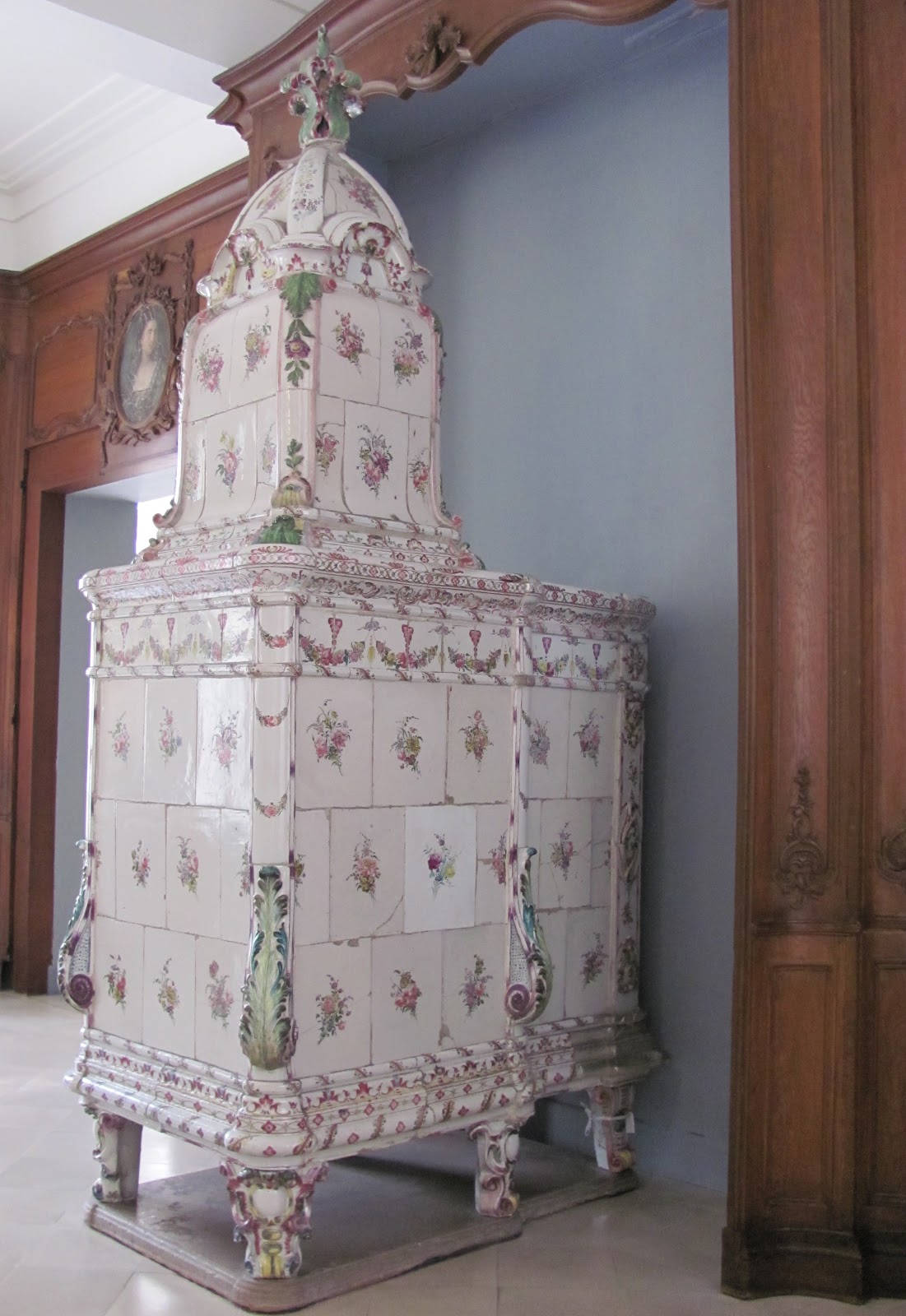
Audrey :  We found these pretty and very large things all of ceramic tiles ... 
Lillian :   Ceramic or tile stoves.  They are basically heaters.  


Not sure why this one has an urn on top - but I guess the heat was meant to escape through the lattice ...


Audrey :  So many things to discover, so much to learn.  


And then we found the room full of miniatures ... doll sized portraits of people!


Lillian :  Yes, mostly on ivory, some beautifully done.  We'll show you the best photos of the best outfits ...
Audrey :  Just look at these bonnets!


Lillian :  There were lots of military gentlemen ... the early 1800s was a time of wars and upheaval.

Audrey : Probably slightly later - a chap with an interesting moustache.
Lillian :  We had a lot of fun in the Ducal Palace part of the le Musée Lorrain -

Audrey : Then we had some lunch and in the afternoon, we came back to explore the other part of the museum - the folk art, regional furniture & traditional Lorraine interiors housed in the ex-Franciscan monastery next door to the palace.  
Lillian :  Let us show you our photos of all that in the next post.