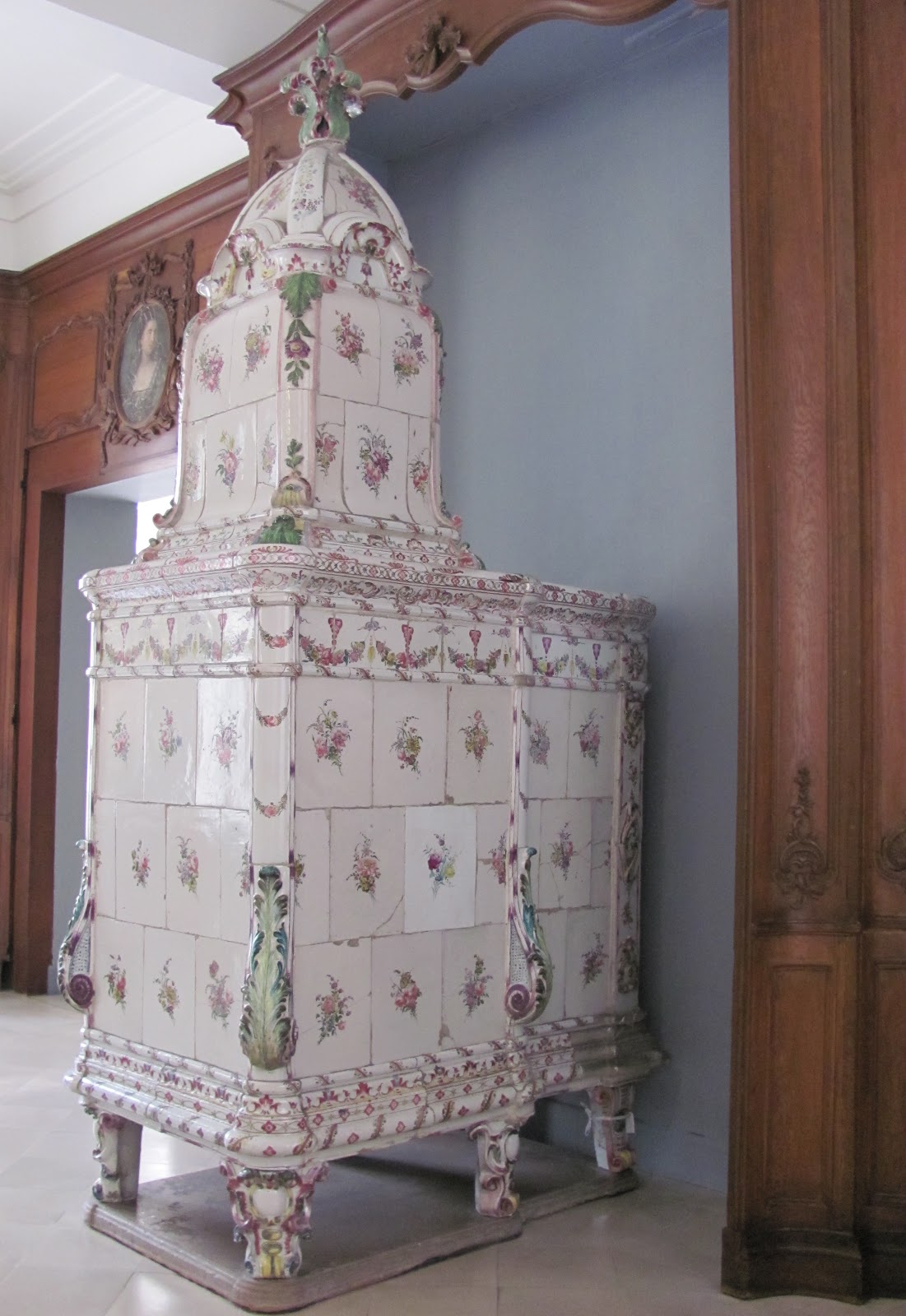
Lillian: Oh dear - this blog has been completely neglected of late. But here we are back again where we left off - in Nancy, visiting some wonderful museums.
Audrey: We took a lunch break between visiting the Ducal Palace - le Musée Lorrain and the adjoining couvent des Cordeliers (a Franciscan Convent) that now houses the Museum of Popular Arts and Traditions ...

Bought from a busy boulangerie and eaten en plein air near this statue.

Audrey: His uniform and moustache are most impressive - who was he?
Lillian: The plinth reads Hubert Lyautey - Marechal de France - 1854 - 1934. He was born in Nancy, here is the Wikipedia article about him.
Audrey: I would like a great big cape like that - all dramatic and swishy.
Lillian: Well, after paying our compliments to Hubert we went to the old Cordeliers Convent.
Now our people strongly recommend visiting this sort of museum - they go under different names - "Folk Museum" "Traditional Life" "Popular ..." and they house displays form the everyday life of the people of the area. They really help you to gain a feel for the history of the region - how people lived, what they harested, what they crafted, what was important to them. Which wars, revolutions, upheavals affected them and how. This really gives you a feel for a place, a much greater & more in-depth understanding of a region. Plus, you get to see some really interesting things.
Audrey: SO ... if you are in Nancy, France and visiting the Ducal Palace - do get the ticket that gives you admission to the Convent too, it's not expensive and well worth it - to sample "La vie quotidienne des Lorrains" "Daily life in Lorraine, from the end of the 18th century to the beginning of the 20th century ... depicted in arts and crafts and in the ethnographic collection in the Franciscan Convent: regional furniture, popular faïence and household items shown in highly evocative, traditional Lorraine interiors."
Lillian: Wood in many forms, featured in the life of the area and the region of Lorraine is still famous for its large and diverse forests. A massive sled for getting timber out of those forests in the winter.

 and a massive farmhouse fireplace where some of that timber would've been burnt.
Audrey: Limestone flags on the floor and by that fireplace there were some cute bits of furniture ...


"Lacemaker's Stool"
from around Charmes (Vosges) 19th C.
If they are not, strictly speaking stools, these small pieces of furniture upon which lacemakers placed their cushions [or "pillows" ed.] come close in shape. Some were of excellent quality but many were 'home-made'. They had three legs united by a spacer, the tray is a thick plank with slightly serrated edges."
Audrey: Our stylist wants to learn how to make bobbin or pillow lace (dentelle de fuseau) so she was delighted by that funny little table. Though we are at a loss to explain what those serrated edges are for - perhaps if the lacemaker dropped a bundle of her bobbins the serrations would stop them getting too tangled up ?
Lillian: Our stylist does some hand-spinning - so this old photograph also made her happy.
 If looks like wool, she is using a distaff and a lovely little wheel. Not sure what the tall stand next to her is for, perhaps to hold a lamp or that distaff.
Another old photo of an interior shows a similar spinning wheel.

Audrey: Here is another old photo but this one made us all a bit dismayed!
 |
| Ironing - it never ends! |
Audrey: And her lovely cap with the neat bow under her chin. The frill is beautifully goffered and they used special goffering irons to do that - this was a very skillful lady.
 Lillian: Lots of skillful & hard-working women - this painting in the naive style shows a lady doing tambour work by a garden wall. She wears a widow's cap and enormous wooden clogs / sabots. Tambour work is stretched "drum tight" (hence the name) on a frame, upside down - there are 2 threads (which the painter has omitted!) one on top (wrong side) and the right side thread - often with beads on. You use a tiny, sharp hook to punch thru the fabric to pick up the right-side thread and loop it through... the wrong side of tambour work is always in chain stitch.
 It looks like this lady is beading some lace.
Audrey: I hope she can see what she is doing!
Lillian: Well, back to the timber - in the photos above you might have noticed the gorgeous furniture. With all the lovely wood in the region, furniture making was an important industry
 |
| lovely armoire |
 |
| lovely kitchen dresser |
 |
| bed & wardrobe combined |
Lillian: The curtaining was more about keeping warm - it gets cold in the winter.
Audrey: All the beds were really small too, was this furniture for children?
Lillian: No dear, it's just that people were smaller back then. But this lovely crib with inlay work was for a baby.

Audrey: I liked the wall-paper in that room - it would make a pretty dress.

Lillian: All these interiors were ordinary people's homes & farmhouses.
Lillian: Our people liked the oil lamps - and please excuse the electric light in this photo - ironic and far too bright!


here is another, more basic model. Both have a mechanism - for adjusting the height?
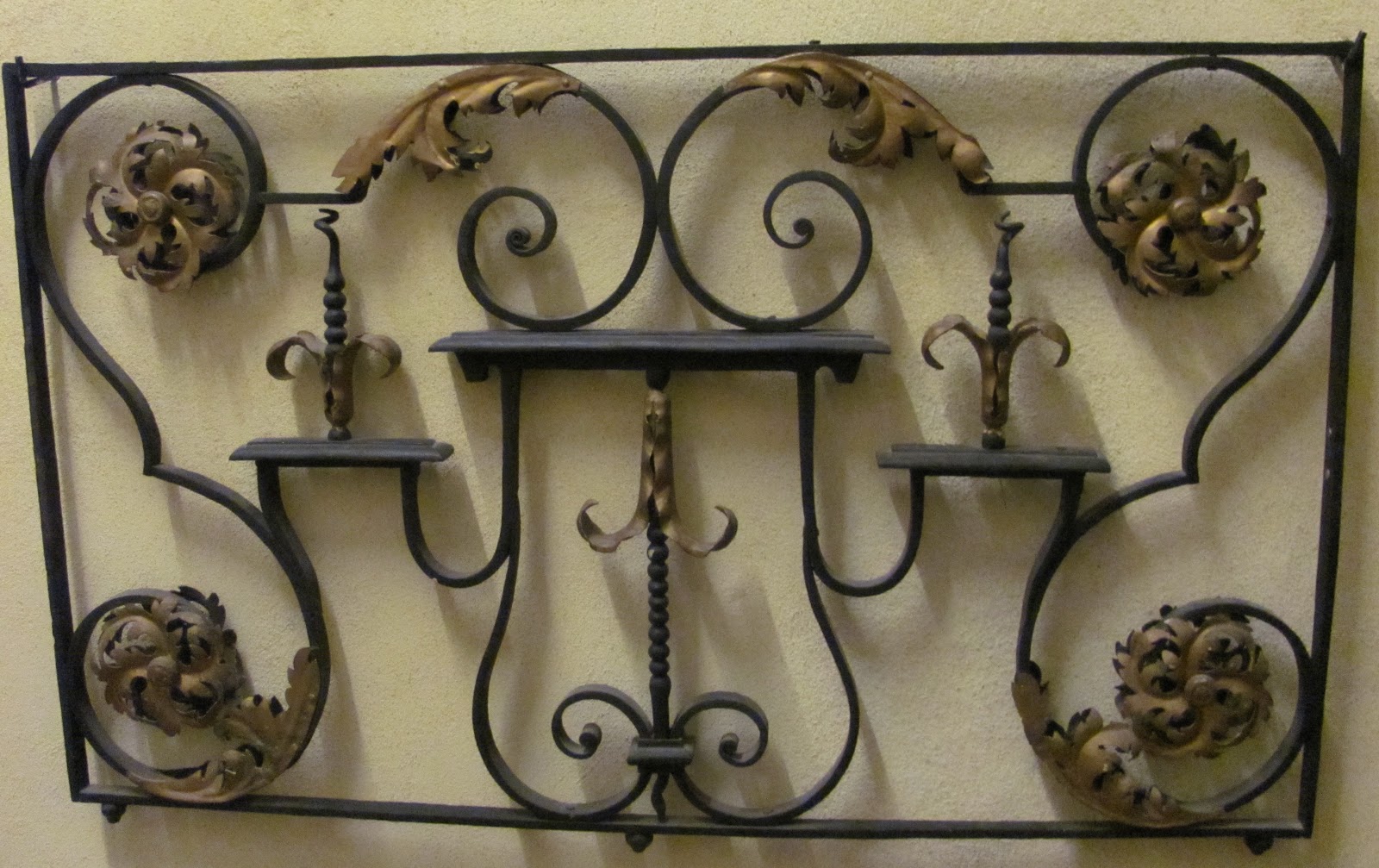
Audrey: Some more random metal-work. I think I'll have this design on my balcony when I star in Romeo and Juliet.
Lillian: And when we both 'star' as sweet country girls harvesting rosy-red apples - we'll wear baskets on our backs like this one?
 |
| hotte pour le transport des fruits |

Audrey: Hmmm perhaps we could modify that design - I think it would make a nice dolly carrier if it weren't so deep.
Lillian: Here is a carved and painted wooden saint - she carries a palm frond so she is a matyr though we don't know her name.


Audrey: Love the way she has used a scarf to solve the problem of tiara-slip and to tie up her pony-tails at the same time. Ingenious - I must remember this next time I'm wearing my tiara.
Lillian: Enough "Fashion Tips from Statues of Saints" and back to the museum. They have a room set up as a "Boulangerie et Patisserie" with a wonderful big dresser - and tables with a slight slope for drainage (for cheese making?)

 |
| "gaufres en fonte" |
and wonderful waffle irons.
Here is one in detail.
Audrey: You have to read it backwards -
"Nourissier - a moittesier - 1750" Eeep that's a long time ago!

Lillian: The top line is probably something about nourishing / nourishment but we can't make anything out of the middle line!
 Audrey: Kitchens just don't look like this nowadays - the long, shallow, stone sinks are interesting -
  as is this marvelous bit of plumbing - the tap is quite lovely.
Lillian: Well, after our day exploring museums our heads were full of all the things we had seen and learnt but our little feet were quite sore so when we saw this fountain in the Place d'Alliance -

 we just couldn't resist taking off our shoes & boots and dipping our sore toes in the water.
Audrey: The square was designed by Emmanuel Héré (we found a statue of him too) and the fountain is by Cyfflé. It commemorates the alliance signed between Louis XV and Marie-Thérèse of Austria in 1756.
The baby on the top says so too -

Lillian: A cooling paddle in a fountain at the end of a lovely day - what could be better!