This post should come with a "partial nudity" warning. Art Nouveau artists were inspired by many lovely things such as flowers & women ...
Lillian : Nancy is a wonderful place to see Art Nouveau and a visit to the
Musée de l’École de Nancy is a delight for anyone interested in the style -
Audrey : Or if you just like seeing beautiful things that have been beautifully made.
Lillian : Quite! It is lovely to see complete sets of furniture, with paintings, lamps, vases ... all presented in a natural way in the rooms of the house.
 Audrey
 : The painting you can see part of there is by
Victor Prouvé - it is of 3 lovely ladies in soft, pretty dresses, painted in 1903. The furniture is by
Louis Majorelle, his
Ensemble aux nénuphars (French for waterlilies) 1900.

 Lillian
 : The details - the way the shapes of waterlily leaves and stems are suggested in the shapes of the legs, the turned up edges of the desk-top, the table ... just lovely!

 Audrey
 : Detail of a chair - also by Louis Majorelle -
Chaise Pavots (poppies), very elegant.
Lillian : This room -
Salle a manger (dining room) by
Eugène Vallin &
Victor Prouvé - was a trifle over-whelming!

The original room was somewhat larger so the beautiful painted ceiling has actually been cut down a little. The light-fitting is gorgeous.
And here is a close-up picture of the tea-set.
 Audrey
 : Of course, electric light was a wonderful new thing when these Art Nouveau artistes were creating & designing. They even found wonderfully clever ways to use light bulbs -

isn't that delightful? I wanted to stand under that light and wait for everyone to give me kisses - but our people wanted to see
everything in the museum ...
 Lillian
 : And there is so much to see! we can only show you a tiny amount here.
This lovely set of lights in glass gourds is by
Emile Gallé, 1902.
The foliage is made of iron, and I think that would look wonderful under a verandah.
 Lillian
 : The Art Nouveau movement held that everything can & should be made beautiful (as well as practical). So a lovely painting is put into a gorgeous frame - with a dragonfly perhaps.

 Audrey
 : Even a bath-tub! Not merely a place to get clean but an amazing grotto complete with water plants and nymph!
And all done in ceramic tiles.
 Audrey
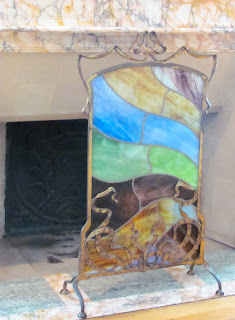
 : This fire-screen is inspired by the ocean with glass 'waves' and metal 'sea-weed''.
Lillian : I think that is what the French call
verre américain - opalescent glass, invented by Tiffany & Co.
Audrey : Let's see more lovely lead-light work... The top of a display cabinet with pretty birds.
 Lillian
 : A window with a lovely lady in a garden - hope she is using sun-screen!

Pretty peacocks and curling fern-fronds in the corners.
Audrey : The lady has a kitty - and kitty wants a cuddle.
 Lillian
 : This very pretty window with roses is on the landing of the stairs.
Audrey : And this massive window - almost 3.5m long - is by
Jacques Gruber 1904 (see our previous post for more of Monsieur Gruber's wonderful works in glass).


Some detail - the irises are of
verre américain.
Audrey : Let's see more lovely glass - this time in vases.
 Lillian
 : Ah - some of the vases are displayed near a window so the sunlight shines through them. This fern frond vase caught our stylist's eye.
 Audrey
 : Downstairs there is a collection of glass-work by
Emile Gallé
the colour in this vase is stunning.

This is called
Ipoméa et Phalènes, it was in the Exposition universelle de Paris in 1900 but then the base was also of glass. It seems that it had an accident back then and was given a new bronze base. The moths have been applied by a marqueterie technique (
see here for info).
Lillian : Here is some more marquetry, the more common sort - in timber. Some very delicate insects.
Lillian : And a delightful trinket box with tulips and a moth - by
Emile Gallé. Those Art Nouveau artists designed and made everything!
Lillian : In our next post we will show you the lovely gardens of this museum. But now we'll leave you with some details from a large painting that delighted our stylist. Unfortunately we don't know who painted this, our photographer couldn't find a signature and it is not in the big book our people bought from the Musée.

It shows women working at all sorts of textiles - here we see 2 ladies hand sewing and the lady bent over the tambour frame is busy embroidering or beading.
In the LH corner there is a lady making lace - bobbin (or pillow) lace
Dentelle au Fuseau. She is using a pillow with a roller (for making long lengths of lace) the French call this a
carreau traditionnel and
her bobbins don't have the beads (or spangles) found on English bobbins - European lace-makers use wooden bobbins of different shapes (like these) - no beads.
 Lillian : The grounds of the Musée de l’École de Nancy has a wonderful garden full of lovely flowers - and there are some wonderful Art Nouveau things too ...


